This page is a temporary solution. I must have a killer solving techniques page on my main website, but the SumoCue program is still under development and I have not learned all solving techniques myself. Even the ones that I do know are sometimes hard to explain. This page is the w.i.p. version of what will be a sophisticated solving guide for killers on my website.
Terminology Used
A Killer Sudoku is a puzzle with 9 rows of 9 cells each. Vertically, there are 9 columns. This grid of 81 cells is also divided in 9 nonets of 3×3 cells. Nonet is a fancy word for “group of 9”. These groups are also called regions, blocks, or boxes. Rows are numbered from top to bottom, columns from left to right and nonets 1,2,3 for the top layer, 4,5,6 for the middle layer and 7,8,9 for the bottom layer. You can recognize the nonets by the thicker or darker borders separating them.
Together, we call rows, columns and nonets houses, as they all have the same constraint of requiring digits 1 though 9. The terms unit or group are sometimes used in stead of house.
The dotted shapes with a number in the left top corner we call cages. A cage encloses between 1 and 9 cells. Sometimes a cage of size 1 is not shown as a cage, because we already know what digits goes into the cell. This cell then contains a given digit. The number in the left top is the cage sum, or simply the sum. Cages are identified by their sum, size and location. Sometimes the size is omitted, when there is only a single cage with that sum. The “cage 9[2] in N5” is the cage with sum 5, has 2 cells and lies within nonet 5.
The mission in solving a killer is to place a digit in each of the cells in such a way that each house contains all digits 1 though 9, and the sum of the digits within each cage equals the cage sum. Once you have accomplished that feat, you have found the solution.
In this guide, there is a clear distinction between placed digits and candidates. The candidates are the remaining possible digits for a cell. When a placement or a solving technique causes certain candidates to become invalid, we say that these candidates are eliminated or removed. The process of eliminating candidates is also called reduction.
The possible digit combinations within a cage are written in curly brackets, like {1,2,4}. This does not tell us which digit goes into which cell, but it limits the number of candidates for each cell within the cage. A digit that cannot be used in a valid combination is an obsolete digit or candidate. A digit that is found in every possible combination is a mandatory digit.
More specific terminology will be explained when they are introduced with specific techniques.
The Killer Convention
This killer solving guide is written with the killer convention in mind. This convention is used by most killer publishers, after it was originally introduced by the Times newspaper. Each digit is unique within a cage, even when repeats would be allowed by normal sudoku rules. This convention allows us to treat all cages in the same way. It also narrows down the number of digit combinations. Further more, the maximum size for a cage is thus limited to 9, including all digits from 1 through 9.
Use pencilmarks
Unless you have a photographic memory, you should use pencilmarks to write down which values go into each cell. More than with regular sudokus, solving a killer is often achieved by long series of candidate eliminations. In regular sudoku, a few of those steps appear in the 2 or 3 bottlenecks that a difficult sudoku has, but killers seem to require candidate eliminations all the way to the end.
Regular sudoku techniques
Each variation of sudoku has this line: All the techniques that you would use for a regular sudoku do also apply. This being true, do not expect many advanced regular sudoku techniques in a killer. It is just too difficult to create a killer with advanced techniques like swordfish or coloring. There are a few techniques that can be used in killers on a regular basis:
- Hidden singles
- Naked singles
- Line-box interactions (a.k.a locked candidates or pointing pairs)
- Naked subsets (often aligned with a cage)
- Hidden subsets
- X-Wing
- Uniqueness test
The use of uniqueness test requires a warning. You can only perform them if the 4 cells of the unique rectangle are located in 2 rows, 2 columns, 2 nonets and 2 cages. This happens a lot in killers, making this technique very useful to learn and apply.
X-Wings can occur when two aligned size 2 cages are reduced to a single pair, sharing a digit.
Little Arithmetics
You need to perform a lot of little calculations when solving a killer, making this type of puzzle hated by one group of people and loved by others. Use any tool you want when doing these calculations, but beware: errors in calculations are catastrophic when it comes to solving a killer. A single digit off will send you in a completely wrong direction, with no means to trace back to the error point. People who solve these puzzles by hand often measure the difficulty by the number restarts that they needed.
Practice the table of 45
The numbers 1 through 9, when added together, sum up to 45. You know that each row, column and nonet requires digits 1 though 9, so the sum of each house is 45. The sum of 2 adjacent rows is 90. You also need to know 3 x 45 (135) and 4 x 45 (180). This is all you need. For 5 rows, you can also test the remaining 4 rows. There are only 9 rows, columns and nonets, after all.
Innies and outies
When you look at the cages located inside a house, you often find one or more cages that are only partially located inside that house. A part of the cage sticks out. Now when you omit such a cage, the cells from that cage inside the house are called ‘innies’. When on the other hand you include that cage in your calculations, the cells sticking out of the house are called ‘outies’. As killer solvers, we are very interested in innies and outies, because they are the most important tools to solve the puzzle.
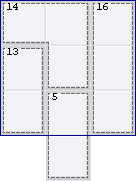
This is a nonet with a single cage that has a partial overlap. Three cages are completely located inside the nonet. With the 5[2] cage included, the sum of all cages equals 48. The single outie must be 3, because all cells inside the nonet add up to 45. You can also choose to calculate the innie. Now omit the 5[2] cage and the sum of the remaining cages is 43. The innie must be 2 to complete the total of 45 for the nonet.
Now check the following situation:
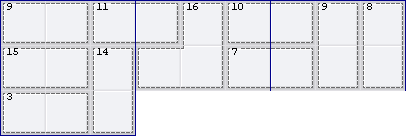
There is a similar 11[2] cage on the edge of the first nonet, but there is also a 14[2] cage on the edge of rows 1 & 2 combined. The sum of all other cages in these 2 rows equals 85, so the innie must be 90 – 85 = 5 and the outie 9.
You can perform these 45 test right at the beginning. In a later stage, you should watch out for new 45 test that may become available, because the number of innies and outies are reduced by placements. Here is an example that shows how this happens:
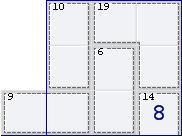
The 8 in the 14[2] cage allows us to do a new 45 test to determine the placements in the 9[2] cage. We can now add 10 + 19 + 6 + 8 = 43. The innie of the 9[2] cage will be 2, the outie will be 7.
Innie or Outie pairs
Sometimes, when it is not possible to make an immediate placement, you can still do eliminations with a 45 test. This can help you move forward in your solving effort. Here is an example:
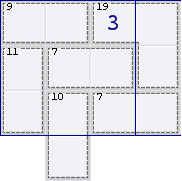
The 19[3] cage can be ignored, because of the 3 placed inside the nonet. This leaves 2 outies. When adding the cages sums, we get 9 + 3 + 11 + 7 + 10 + 7 = 47. This leaves 2 for both outies. As we can see, they cannot see each other, so it is no problem to give them both the same digit 1. The innie for the 7[2] cage will be 6 and the innie in the 10[2] cage will receive a 9.
Here is a practice puzzle for innies and outies. It starts with the outer columns, and works its way to the interior. Do not forget to check the nonet boundaries.
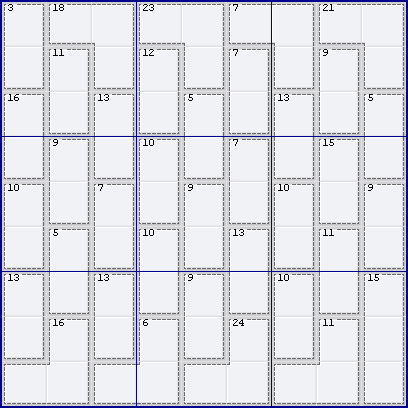
The following code can be copied and pasted in SumoCue:
SumoCueV1
=3=18+1=23+3=7+5=21+7+0=11+1=12+3=7+5=9+7=16
+10=13+12=5+14=13+16=5+18=9+20=10+22=7+24=15
+26=10+28=7+30=9+32=10+34=9+36=5+38=10+40=13
+42=11+44=13+46=13+48=9+50=10+52=15+54=16+56
=6+58=24+60=11+62+64+64+66+66+68+68+70+70+62
Minimum and Maximum Cages
The sum value on the cages is not only useful for adding and subtracting, it can sometimes tell us immediately what digits the cage contains. A cage with sum 3 and size 2 (written as 3[2] in this manual) can contain digits 1 and 2. Nothing else fits. A cage 4[2] can only contain digits 1 and 3, because 2+2 is not a valid combination.
Here are all cage sums upto size 4 that only have a single configuration:
3[2] = {1,2}
4[2] = {1,3}
16[2] = {7,9}
17[2] = {8,9}
6[3] = {1,2,3}
7[3] = {1,2,4}
23[3] = {6,8,9}
24[3] = {7,8,9}
10[4] = {1,2,3,4}
11[4] = {1,2,3,5}
29[4] = {5,7,8,9}
30[4] = {6,7,8,9}
You can eliminate these candidates from all cells that can be seen by all members of the cage. This is very similar to naked subset reductions. When the entire cage lies within a row, column or nonet, the cage can also be seen as a naked subset within that house.
What does it mean when we say that a cell can see another cell?
This is a term that is often used in sudoku solving guides. Two cells that belong to the same row, column or nonet (3×3 box) cannot both have the same value. In killer sudoku, according to the killer convention, two cells that belong to the same cage can also see each other. Alternatively, these cells are called buddies or peers.
Almost Minimum and Maximum Cages
There are some cage sums that leave a choice of digits, but some of the digits are always part of the configuration. These cages allow us to eliminate candidates for those digits outside the cage.
Here are a few examples. Unfortunately, there are no almost minimum or maximum cages of size 2.
8[3] = {1,2,5} or {1,3,4}
22[3] = {5,8,9} or {6,7,9}
12[4] = {1,2,3,6} or {1,2,4,5}
13[4] = {1,2,3,7} or {1,2,4,6} or {1,3,4,5}
27[4] = {3,7,8,9} or {4,6,8,9} or {5,6,7,9}
28[4] = {4,7,8,9} or {5,6,8,9}
It is rare to find larger cages inside a single house, making it unlikely that you can perform reductions for these larger cages, but in harder puzzles, these may be the key to solving it.
Work the Pairs
Killer sudoku with many cages of size 2, or with little elbow cages of size 3 offer an opportunity to reduce a large part of the puzzle to pairs. This stage of killer solving is commonly known as working the pairs. You start with a minimum or maximum cage and perform the reductions, which, in turn, will reduce the number of possible configurations in other cages, having a ripple effect throughout the puzzle.
Here is an example, so the you can have a taste for this technique.
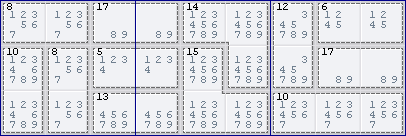
Start with the two 17[2] cages. They eliminate candidates 8 and 9 from the remainder of the first two rows. Then look at the 12[2] cage. Because 8 and 9 are out of the running, it can only contain {5,7}. Eliminate 5 and 7 in the third nonet. Now the 6[2] cage can no longer contain {1,5}, so it must be {2,4}. The 10[3] cage is reduced to {1,3,6}. This cage is neatly aligned with the third row, so you can eliminate these 3 digits from the remainder of that row. After a few more reductions, this is the result:
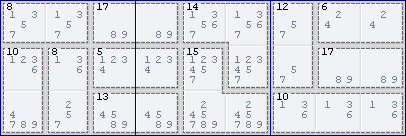
At this stage, you need input from other parts of the puzzle to continue. In easy or gentle killers, working the pairs in combination with a few 45 placements is all you need to solve the puzzle. Because this can be done so quickly, some players consider Killer Sudokus easier to solve than regular Sudokus. That is certainly true for these easier types, but you haven’t finished reading yet!
Here is the complete puzzle. It gives you some practice on this topic:
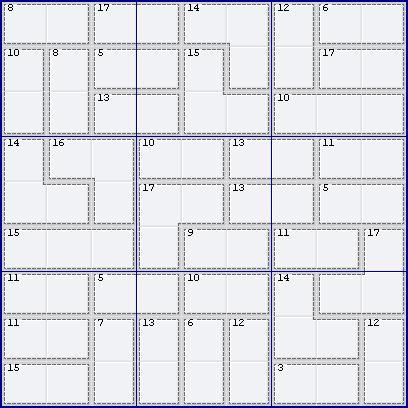
SumoCueV1
=8+0=17+2=14+4=12=6+7=10=8=5+11=15+4+6=17+16+9
+10=13+20+13+13=10+24+24=14=16+28=10+30=13+32
=11+34+27+27+28=17+39=13+41=5+43=15+45+45+39
=9+49=11+51=17=11+54=5+56=10+58=14+53+53=11+63
=7=13=6=12+60+60=12=15+72+65+66+67+68=3+78+71
Regular Sudoku Techniques (reprise)
When you are working the pairs, it is good practice to check for opportunities using regular sudoku solving techniques. Hidden and naked singles often emerge after a few reductions, but line-box interactions can also become available as more and more candidates are eliminated. Because so many cells are reduced to pairs and triples, you can also find naked pairs and triples, which are not confined to a single cage.
Cage Splitting
When larger cages cross the boundary of a 45 test area, it can be useful to split these cages in two parts. Both parts can be treated as separate cages, but the constraint (no repeats) of the original cage also applies. This gives you 3 times the solving power or the original cage.
Here is an example:
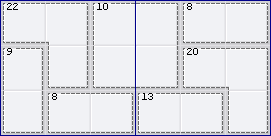
The 10[4] cage lies exactly in the middle of the 2 nonets. 22+9+8=39, so the left nonet receives a 6[2] part and the right nonet receives the 4[2] part. Since the 10[4] cage can only contain {1,2,3,4}, there is only one way to split these candidates: {2,4} and {1,3}. Thus, the useles quad has been split into two very productive pairs.